
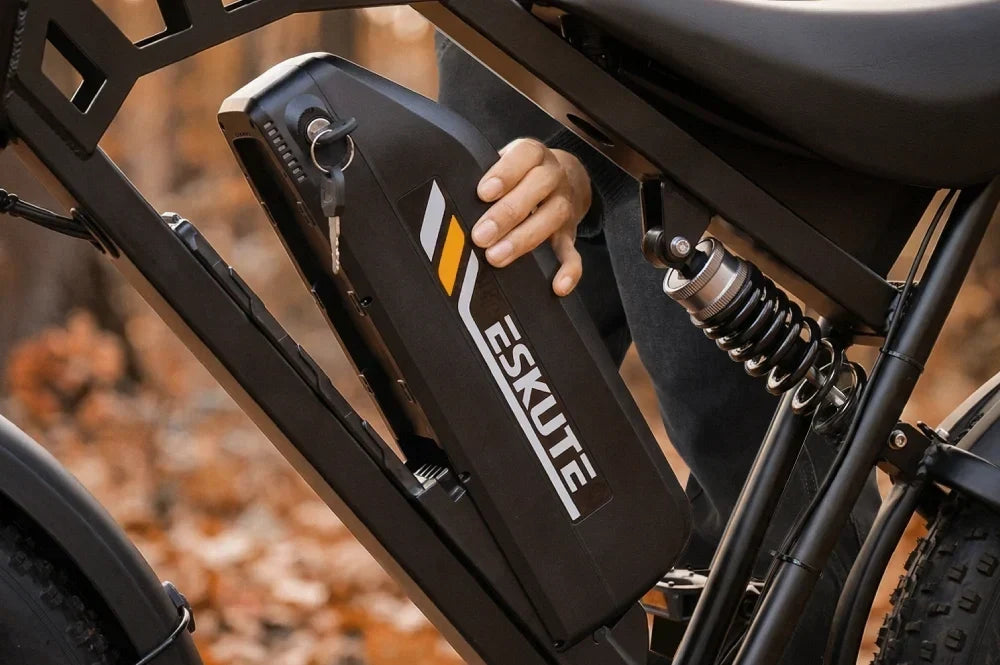
When shopping for an electric bike, technical battery specifications like Volts (V), Amp-hours (Ah), and Watt-hours (Wh) can easily feel overwhelming. However, understanding these numbers is the single best way to evaluate how far an e-bike can actually take you on a single charge.
One of Eskute’s most powerful energy systems is the 48V 20.8Ah battery pack. In this technical yet accessible guide, we will break down what 48V 20.8Ah—or 998.4 Watt-hours—means in real-world performance, how charging works, and how to maximize your battery's lifespan.
What Does 48V 20.8Ah Actually Mean?
To understand an e-bike battery, think of Voltage as the "power flow" and Amp-hours as the "fuel tank size":
- Voltage (48V): Measures the electrical potential. Higher voltage (48V vs 36V) allows the system to deliver power to the motor more efficiently, especially when accelerating or climbing hills under load.
- Amp-Hours (20.8Ah): Measures electrical capacity over time. A 20.8Ah rating indicates a substantial "fuel tank" capable of delivering power over extended journeys.
Watt-Hours: The Ultimate Capacity Metric
To make fair comparisons between different batteries, multiply Voltage by Amp-hours to get Watt-hours (Wh):
48V x 20.8Ah = 998.4Wh
Nearly 1,000 Watt-hours represents a massive energy reserve for a consumer electric bike. Here is how Eskute's battery lineup compares:
| Battery Specification | Energy Capacity (Wh) | Eskute Models Featured On |
|
36V 13Ah
|
468 Wh |
Eskute C100 Plus |
|
48V 17.5Ah
|
840 Wh |
Eskute C202 |
| 48V 20.8Ah | 998.4 Wh | Eskute D202, V202, T302 Pro |
How Far Can a 48V 20.8Ah Battery Go?
In theoretical terms, an average electric bike consumes between 8 Wh and 14 Wh per kilometer, depending on terrain and assist levels. Dividing 998.4 Wh by an average rate of 10 Wh/km yields an estimated potential range of 80 to 100+ kilometers.
What Affects Your Real-World Range?
Real-world mileage varies based on several critical factors:
- Pedal Assist Level: Riding in Eco Mode uses minimal battery power, whereas Turbo/High Assist drains energy rapidly.
- Total Weight: Carrying extra luggage or groceries requires more energy from the motor.
- Tire Resistance: Wide fat tires (like those on the D202 and V202) offer excellent traction but higher rolling resistance than narrow city tires.
- Ambient Temperature: Lithium-ion battery efficiency drops temporarily in freezing cold winter temperatures (below 5°C).
- Terrain & Stops: Continuous flat riding uses significantly less power than frequent stop-and-go city traffic or steep hill climbs.
Charging Time and Best Practices
The Eskute 48V 20.8Ah battery pack charges fully in approximately 7.5 to 8.5 hours using the official charger.
Key Charging Safety Guidelines:
- Use Official Chargers Only: Always charge with the original charger supplied by Eskute. Unapproved fast-chargers can damage battery management systems (BMS) and void your warranty.
- Charge at Ambient Temperatures: Never charge a battery that is frozen. Bring the battery indoors and allow it to reach room temperature (15°C–25°C) before plugging it in.
- Dry Environment: Ensure the charging port and wall outlet are clean and free of moisture.
Benefits of a Removable Battery
All Eskute models using the 48V 20.8Ah battery feature key-locked, removable designs. This offers major everyday conveniences:
- Indoor Charging: Charge the battery at your desk or inside your apartment without hauling the entire bike inside.
- Theft Prevention: Take the battery with you when parking your e-bike in public spaces.
- Winter Storage: Protect battery life by storing the unit inside heated living spaces during freezing months.
How to Extend Your Battery's Lifespan
To get 3 to 5+ years of optimal performance out of your 48V 20.8Ah lithium battery, follow these battery care rules:
- Avoid Complete Discharges: Do not leave the battery at 0% for extended periods. Recharge when it drops to around 20%.
- Optimal Storage Charge: If storing the e-bike unused for winter, keep the battery charged to around 50%–70% and check it every month.
- Keep It Clean: Wipe external electrical contacts gently with a dry cloth; never use high-pressure water jets near the battery junction.
Frequently Asked Questions
Q: How many watt-hours is a 48V 20.8Ah battery?
A: Exactly 998.4 Watt-hours (Wh).
Q: Can I use a third-party fast charger to speed up charging?
A: We strongly advise against using uncertified third-party chargers. Always verify voltage, amperage compatibility, and official manufacturer approval to prevent overheating or damaging the internal Battery Management System (BMS).


Leave a comment
This site is protected by hCaptcha and the hCaptcha Privacy Policy and Terms of Service apply.