
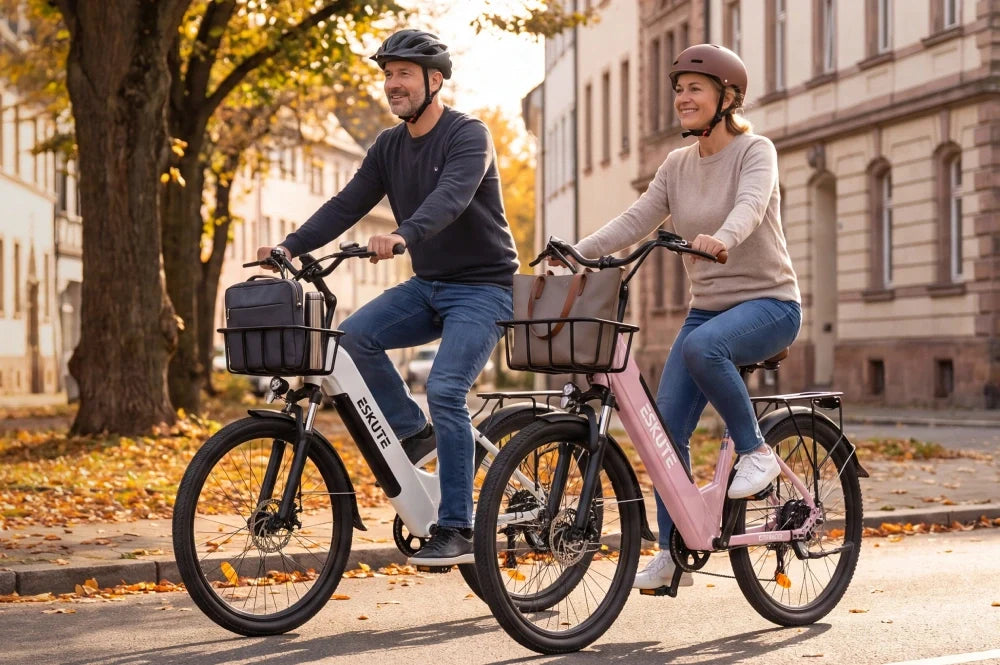
City e-bikes have transformed the way urban commuters navigate daily life, offering a faster, eco-friendly, and cost-effective alternative to cars and public transport. If you are looking for an accessible step-through electric bike for your daily routine, Eskute offers two highly compelling options: the C100 Plus and the C202.
While both models share a user-friendly step-through frame design and smooth pedal assistance, they cater to different riding priorities. The C100 Plus focuses on maximum affordability, lighter overall weight, and straightforward daily commuting. On the other hand, the C202 is built for riders who need enhanced motor torque, a larger battery capacity, and extended range for longer or hillier routes.
In this head-to-head C100 Plus vs C202 comparison, we break down their performance, comfort features, battery life, and practical usability to help you decide which Eskute city e-bike fits your lifestyle best.
C100 Plus vs C202 at a Glance
Before diving into details, here is a quick specs comparison between the two models:
| Specification | Eskute C100 Plus | Eskute C202 |
| Category Position |
Affordable, lightweight daily commuter |
Long-range, higher-torque city e-bike |
| Motor & Torque |
250W Rear Hub / 45 Nm |
250W Rear Hub / 65 Nm |
| Battery Specs |
36V 13Ah |
48V 17.5Ah |
| Range |
Up to 80 km |
70 – 110 km |
| Tires |
26" × 2.1" City Tires |
26" × 2.1" City Tires |
| Bike Weight |
Approx. 26 kg |
Approx. 31 kg |
| Max Payload |
120 kg |
120 kg |
| Recommended Height |
155 – 190 cm |
160 – 190 cm |
| Key Advantage |
Lower weight, lower price point |
Stronger hill climbing, longer battery life |
*Note: Real-world range depends heavily on pedal assist level, rider weight, road incline, weather conditions, tire pressure, and added payload.
Battery and Real-World Range
C100 Plus — Enough Range for Routine City Trips
The C100 Plus comes equipped with a 36V 13Ah battery. For the average city commuter who travels 5 to 15 km per day for work, errands, or local leisure, this battery capacity provides plenty of energy to cover a few days of riding without needing to recharge. The battery is fully removable, meaning you can easily unlock it and bring it indoors to charge at your desk or home.
C202 — More Capacity for Longer Rides and Less Frequent Charging
If your daily journey involves longer distances, steeper gradients, or higher assist levels, the C202 step-up to a 48V 17.5Ah battery makes a noticeable difference. With an estimated range of 70 to 110 km, the C202 allows you to ride further on a single charge and reduces how often you need to plug the bike into the wall.
Which Battery Is Better for Your Weekly Mileage?
- Choose the C100 Plus if your daily routes are mostly flat, under 20 km total, and you do not mind charging every couple of days.
- Choose the C202 if you regularly commute over longer distances, carry heavier bags, tackle inclines, or simply want to minimize charging frequency.
Motor Torque and Hill Performance
Both e-bikes feature standard 250W rear hub motors to comply with European pedelec regulations. However, their torque outputs differ significantly:
- C100 Plus (45 Nm): Delivers smooth, natural acceleration on flat paved roads, light bridges, and gentle city inclines. It offers a balanced, eco-friendly feel for relaxed riding.
- C202 (65 Nm): Provides substantially more pulling power off the line and on steep urban hills. The extra 20 Nm of torque helps you maintain speed against head winds or when hauling groceries in a rear basket.
Comfort and Everyday Handling
Both bikes feature step-through aluminum frames, upright seating positions, front suspension forks, standard 26" city tires, mechanical disc brakes, and integrated rear racks.
However, weight is a crucial difference:
- The C100 Plus weighs approximately 26 kg, making it about 5 kg lighter than the C202. This makes it easier to push up ramps, maneuver through tight hallways, or lift slightly when needed.
- The C202 weighs around 31 kg due to its larger battery and reinforced frame structure. While this adds stability and high-speed road presence, it requires more effort if you frequently need to carry your bike up apartment stairs.
Which E-Bike Is Easier to Live With?
- Commuting and Short City Trips: The C100 Plus is light and responsive for standard city streets.
- Grocery Shopping & Carrying Essentials: Both feature sturdy rear racks, but the C202’s higher torque handles heavier cargo with less effort.
- Charging in an Apartment or Office: Both feature removable keys-locked batteries for convenient indoor charging.
- Storage and Moving the Bike: The C100 Plus takes the win for maneuverability in tight storage spaces.
- Weekend Leisure Rides: The C202’s large battery gives you peace of mind when exploring beyond city limits.
Who Should Choose the C100 Plus?
The Eskute C100 Plus is ideal for you if:
- You are looking for a budget-friendly first city e-bike.
- Your local terrain is predominantly flat.
- You prefer a lighter e-bike that is easier to manage.
- Your daily commutes are relatively short (under 15–20 km round trip).
Who Should Choose the C202?
The Eskute C202 is ideal for you if:
- You face frequent hills, strong headwinds, or ride with heavy loads.
- You want maximum range and want to charge as infrequently as possible.
- You plan to use your e-bike for weekend touring alongside daily commuting.
- You don't mind a slightly heavier frame in exchange for extra power.
Final Verdict
Choosing between these two excellent urban electric bikes comes down to balancing weight and budget against power and range.
- Choose the C100 Plus if affordability, lighter weight, and straightforward daily commuting are your top priorities.
- Choose the C202 if you regularly ride longer distances, encounter steep hills, or desire stronger motor assist and longer battery endurance.
Frequently Asked Questions
Q: Is the C202 worth the extra cost over the C100 Plus?
A: Yes, if you need steep hill-climbing power (65 Nm vs 45 Nm) and significantly longer range. For flat city commutes, the C100 Plus offers better value.
Q: Which Eskute city e-bike is lighter?
A: The C100 Plus is lighter, weighing approximately 26 kg compared to the C202’s 31 kg.
Q: Are both models legal in Germany and the EU?
A: Yes, both models feature 250W motors and speed assistance limited to 25 km/h, fulfilling standard EPAC (pedelec) requirements across Germany and the European Union.

Leave a comment
This site is protected by hCaptcha and the hCaptcha Privacy Policy and Terms of Service apply.