

When deciding on the perfect electric ride, the folding e-bike vs city e-bike debate is one of the most common crossroads for commuters. Both styles offer fantastic ways to cut down on transport costs, breeze past traffic, and enjoy eco-friendly travel. However, they serve vastly different lifestyles and daily commuting needs.
So, which one is right for you? Let's break down the core differences, the pros and cons of each, and help you choose the ideal match for your daily route.

What is a Folding E-Bike?
A folding e-bike is designed with portability and space-saving as top priorities. Featuring a central hinge on the frame, folding handlebars, and typically smaller wheels (usually 20 inches), these bikes collapse into a compact package within seconds.
Pros of Folding E-Bikes:
- Ultimate Portability: Easily fits in the trunk of a car, under your office desk, or next to you on a train.
- Easy Storage: Ideal for apartments or homes without a garage or large cellar.
- Multimodal Commuting: Seamlessly transitions between riding and public transport.
Cons of Folding E-Bikes:
- Smaller Wheels: Smaller tire circumferences mean you may feel bumps in the road more than on a full-sized city bike.
- Riding Geometry: The frame geometry is more compact, which might feel less familiar to traditional cyclists on long-distance journeys.
Eskute Featured Model: The Eskute D202 Folding E-Bike is a prime example of urban convenience. Equipped with a sturdy folding frame, integrated front basket, and a long-range 48V battery, it bridges the gap between massive utility and compact storage.

What is a City E-Bike?
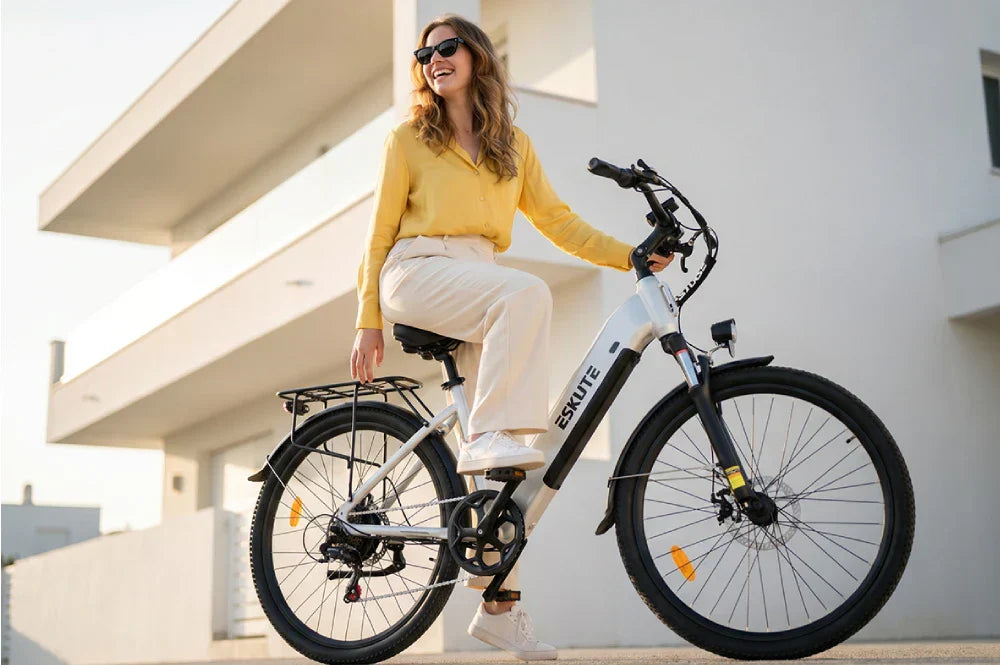
A city e-bike (often referred to as an urban or commuter hybrid) features a traditional full-sized frame with 26-inch or 28-inch wheels. It prioritizes riding comfort, stability, and utility for medium-to-long commutes across paved roads.
Pros of City E-Bikes:
- Smooth & Stable Ride: Large wheels roll over potholes, cobblestones, and road debris with ease.
- Ergonomic Comfort: Often features a step-through frame design (like the Eskute C202) and riser handlebars, allowing you to ride in an upright, back-friendly posture.
- Built-In Practicality: Typically comes equipped with heavy-duty rear racks, mudguards, and integrated lights.
Cons of City E-Bikes:
- Heavy & Bulky: Harder to carry up narrow stairs, lift into trains, or fit into tight storage spaces.
- No Folding Ability: Requires a dedicated bike rack if you plan on transporting it via car.
Eskute Featured Model: The Eskute C202 City E-Bike features an elegant, low-step frame that makes mounting and dismounting completely effortless—even in everyday clothing or office wear. Its large tires and front suspension fork absorb city bumps beautifully.
Key Differences: Folding vs. City E-Bikes
To make your decision easier, here is a quick comparison breakdown of how they stack up in daily scenarios:
| Feature | Folding E-Bike (e.g., Eskute D202) | City E-Bike (e.g., Eskute C202) |
| Wheel Size | Typically 20" (often with Fat Tires for stability) | Typically 26" or 28" (Standard City Tires) |
| Portability | High (Folds in under 15 seconds) | Low (Full-sized frame) |
| Storage Requirement | Minimal (Fits in closets, under desks, car trunks) | Moderate (Requires garage, cellar, or hallway space) |
| Riding Comfort | Moderate (Great for short-to-medium urban trips) | High (Excellent upright posture, ideal for long rides) |
| Weight Capacity | Highly durable, often supports robust cargo | High cargo capability with integrated rear racks |
Which One Should You Choose?
Your ultimate decision comes down to how you plan to integrate the e-bike into your daily life.
Choose City E-Bike if:
- You commute via train or bus: You need a bike that is legal and easy to carry onto public transit during rush hour.
- Space is at a premium: You live in a top-floor apartment without an elevator or don't have a secure outdoor garage.
- You travel frequently: You want a bike that easily tucks into your car boot for weekend getaways.
👉 [Explore the Eskute Folding E-Bike Collection]

Choose City E-Bike if:
- Comfort is your top priority: You have a longer daily commute (over 10 km) and want a smooth, upright, traditional riding experience.
- You regularly carry groceries or gear: You want to make full use of pre-installed cargo racks and frame stability.
- You have easy storage access: You have a secure ground-floor hallway, garage, or bike cellar to park your ride.
👉 [Shop the City E-Bike Collection]

FAQ – Common Questions About Urban E-Bikes
Q1: Are folding e-bikes slower than city e-bikes?
A: No. In Europe, all road-legal pedelecs (including both folding and city models) are electronically limited to assist you up to 25 km/h. The main difference is how quickly they reach that speed and how the ride feels, not the top speed itself.
Q2: Is a folding e-bike safe for longer rides?
A: Absolutely. Modern folding e-bikes use reinforced hinges and robust locking mechanisms. However, for continuous rides longer than 15-20 km, a full-sized city e-bike with standard 26" or 28" wheels will generally offer a less tiring, more comfortable experience.
Q3: Do folding e-bikes require more maintenance?
A: Not significantly. The electric motor, battery, and drivetrain systems are identical to those on city bikes. The only extra step is occasionally checking and cleaning the folding hinges and latches to ensure they remain smooth and securely locked.


Leave a comment
This site is protected by hCaptcha and the hCaptcha Privacy Policy and Terms of Service apply.